Travertine, Shellstone, Limestone & Leathered Marble Compared
Your pool deck is one of the largest visible surfaces on your property and one of the hardest-working. It endures Florida’s relentless sun, daily foot traffic from wet feet, salt air, and the chemical splash-back of pool water. Choosing the wrong stone means hot surfaces, slippery edges, or a maintenance burden that compounds every year. Choosing the right one means a deck that looks exceptional, performs safely, and holds up beautifully for decades.
At Coastal Custom Pool & Spa, we’ve been building pools in Lee and Collier counties since 1994. We’ve specified, installed, and observed every major natural stone option across hundreds of projects from Fort Myers residential builds to elevated coastal estates on Sanibel, Captiva, and Marco Island. Here’s our honest, working breakdown of the four most popular choices.
Travertine
What it is
Travertine is a sedimentary limestone formed around mineral springs, quarried primarily in Turkey and Italy. It’s the most widely used natural stone in Southwest Florida pool construction, and for good reason it offers a proven combination of performance, aesthetics, and value.
Surface & appearance
Travertine has a naturally porous surface with small voids or holes, which are either left open (“unfilled”) or filled with grout before installation. The result is a classic, slightly rustic European look that pairs well with traditional Mediterranean, Tuscan, and old-Florida architecture. It comes in a range of warm earth tones from ivory and cream to walnut and gold.
Performance around pools
- Heat retention: One of travertine’s biggest selling points in Florida. The material stays remarkably cool underfoot even in direct sun significantly cooler than concrete or porcelain pavers.
- Slip resistance: Good, especially in tumbled or brushed finishes. The natural texture provides traction for wet feet.
- Durability: High. Dense travertine holds up well under heavy foot traffic and outdoor conditions.
- Maintenance: Unfilled travertine can trap dirt, algae, and moisture in the voids over time. Filled travertine is easier to clean and seal. Either way, periodic sealing every one to two years is recommended in coastal environments.
Coping & surrounds
Travertine works well for pool coping and performs reliably around the bond beam. It holds up to chlorine splash and salt air when properly sealed. Available in bullnose and tumbled edge profiles.
| SWFL note Travertine dominates the volume market here because it’s familiar to clients and contractors, easy to source locally, and competitively priced. If a client is budget-conscious but still wants natural stone, travertine is almost always the right answer. |
Shellstone (Florida Shellstone / Keystone)
What it is
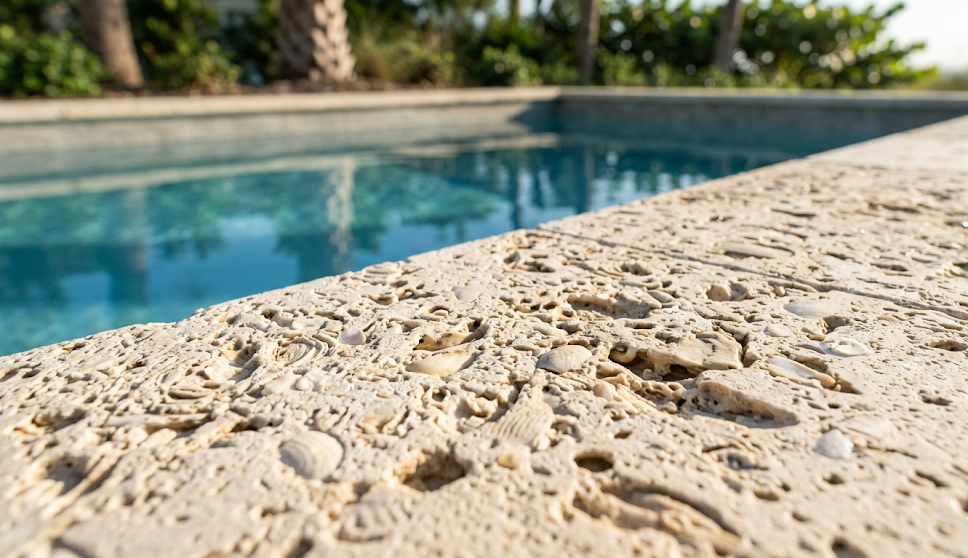
Shellstone is a naturally occurring oolitic limestone quarried right here in Florida primarily from Miami-Dade and Monroe County. It’s sometimes called Florida keystone or Miami limestone. The stone contains natural shell and fossil fragments, giving it a unique, distinctly Florida character.
Surface & appearance
Shellstone has a naturally rough, porous surface with excellent textural variation. The light cream-to-ivory coloring works beautifully in coastal settings and pairs well with tropical and Florida vernacular architecture. The surface irregularity is part of its charm and its best functional attribute.
Performance around pools
- Heat retention: Low. The light color and porous surface help dissipate heat, keeping the deck comfortable underfoot.
- Slip resistance: Outstanding arguably the best of any natural stone option for wet pool surrounds. The naturally rough surface provides traction without requiring special finish processing.
- Durability: Moderate. Shellstone is more fragile under point loads than travertine or limestone. Edges can chip or crack if not properly supported by the substrate.
- Maintenance: Medium. The porous surface requires sealing to prevent staining from tannins, sunscreen, and organic matter. Reseal every one to two years.
Coping & surrounds
Works well for pool coping, but edges require clean cuts and solid substrate support. Thinner edge profiles are a risk specify full support and adequate thickness at the coping nosing.
| SWFL note Shellstone is a strong differentiator for coastal builds. The local-material story resonates on Sanibel, Captiva, and Marco Island projects, and the best-in-class slip resistance is a genuinely practical advantage for families. It’s the material we reach for when a client wants something authentically Florida and functionally superior. |
Limestone
What it is
When pool designers and architects say “limestone,” they typically mean a dense, quarried slab limestone distinct from the sedimentary varieties above. Common sources include Jerusalem stone, French Limestone (Burgundy), Lueders (Texas), and Indiana limestone. These are tighter, harder materials with a more refined appearance.
Surface & appearance
Dense limestone has a more uniform, refined look than travertine or shellstone fewer voids, less visual noise, and a cleaner face. Finishes range from sawn and honed (smooth, tight) to bush-hammered and sandblasted (textured). Light-colored varieties in Jerusalem cream or French beige carry a sophisticated, architectural quality that pairs exceptionally well with contemporary and transitional home designs.
Performance around pools
- Heat retention: Low to moderate. Light-colored varieties perform well in Florida sun; darker limestone can get hot.
- Slip resistance: Finish-dependent this is the critical spec decision. Honed limestone is beautiful and dangerously slippery when wet. Always specify bush-hammered, flamed, or sandblasted finish for any pool surround application.
- Durability: High. Denser than travertine or shellstone holds a clean edge, tolerates heavy loads, and cuts precisely.
- Edge quality: Excellent. Dense limestone is ideal for crisp bullnose, straight, and custom edge profiles on coping.
- Maintenance: Medium. Less porous than travertine or shellstone, but Florida’s climate still calls for periodic sealing.
Coping & surrounds
Excellent coping material. Dense, clean-cutting limestone produces a very tailored, architectural finished edge. Often the material of choice when a designer is coordinating the pool deck with a custom-quarried home exterior.
| SWFL note Limestone is the architect-driven choice. When a designer is specifying the full home exterior palette and wants material cohesion across the pool deck, driveway apron, and entry, dense limestone ties it all together. Contemporary Naples estates and luxury waterfront builds in Collier County are the sweet spot. European sources like Jerusalem and Burgundy carry premium pricing and longer lead times factor that into your project schedule. |
Leathered Marble
What it is
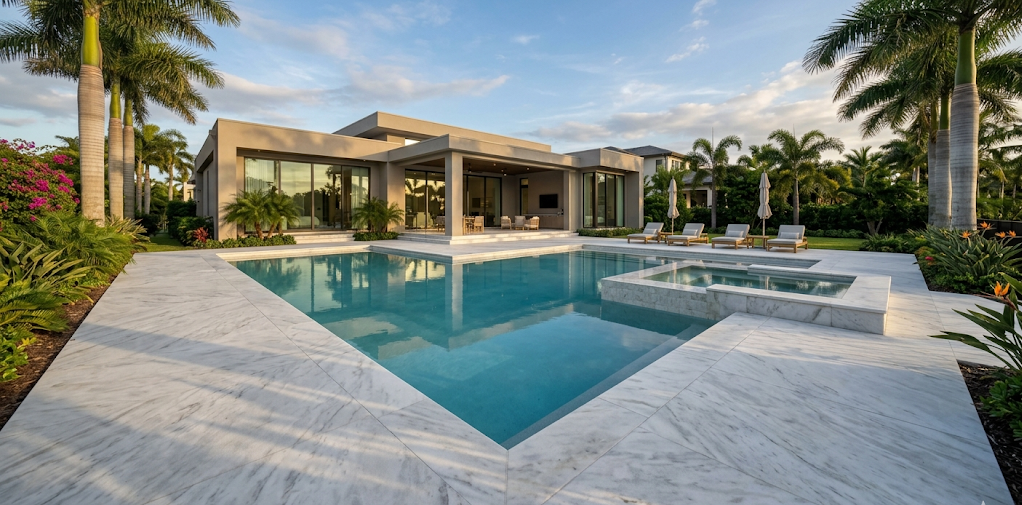
True marble is a metamorphic limestone quarried primarily in Italy, Turkey, and Greece. “Leathered” marble has been processed with diamond-tipped brushes to create a matte, subtly textured surface a step up from standard polished or honed marble in both texture and practical performance. It’s the ultra-luxury option.
Surface & appearance
The leathering process creates a surface that is smooth to the touch but with a subtle undulating texture and sophisticated matte sheen. It hides fingerprints, water spots, and minor etching better than polished marble. The visual effect is refined, intentional, and unmistakably high-end. Color options range from classic Carrara white to dramatic nero marquina black.
Performance around pools
- Heat retention: Moderate. Light-colored varieties (Carrara, Thassos) perform better in Florida’s full sun. Dark marble absorbs heat significantly. Spec accordingly.
- Slip resistance: Moderate. The leathering process adds texture versus polished marble, but additional anti-slip treatment is still recommended in wet pool zones.
- Durability: Moderate. Marble is softer and more reactive than the other three options. It’s vulnerable to acid (pool chemicals, organic staining, citrus, wine) and requires diligent sealing and maintenance to hold its appearance.
- Edge quality: Excellent premium fabrication with refined profiles.
- Maintenance: High. This is the most demanding of the four options. Sealing must be regular and consistent; any lapses will show quickly in a Florida pool environment.
Coping & surrounds
Used in the highest-tier luxury applications, often coordinated with a honed or leathered waterline tile for a cohesive look. Requires careful detailing around the bond beam and diligent follow-up on sealant maintenance.
| SWFL note Leathered marble is reserved for the true luxury tier Naples estates, high-end barrier island builds, projects where the client is leading with aesthetics and budget is not the primary constraint. If the design vision is ultra-premium and maintenance will be handled by a dedicated property manager, marble can be extraordinary. Just make sure the client understands the upkeep commitment before specifying it. |
Side-by-Side Comparison
The table below summarizes the key performance attributes across all four materials. Use it as a starting point for client conversations not a substitute for site-specific evaluation.
| Attribute | Travertine | Shellstone | Limestone | Leathered Marble |
| Stone family | Sed. limestone | FL oolitic limestone | Dense limestone | Metamorphic limestone |
| Origin | Turkey / Italy | Miami-Dade, FL | Jerusalem, France, TX | Italy / Turkey / Greece |
| Price | $ | $$ | $$–$$$ | $$$ |
| Heat retention | Low , stays cool | Low, stays cool | Low to moderate | Moderate |
| Slip resistance | Good | Excellent | Finish-dependent | Moderate |
| Durability | High | Moderate | High | Moderate |
| Edge quality | Good | Moderate | Excellent | Excellent |
| Maintenance | Medium | Medium | Medium | High |
| Coastal suitability | Good (sealed) | Good (sealed) | Good (sealed) | Requires care |
| Best design fit | Traditional, Mediterranean | Florida / Coastal | Modern, Transitional | Ultra-luxury |
Which Stone Is Right for Your Project?
No single material is universally correct. Here’s how we approach the conversation with clients:
Choose travertine if…
- Budget is a meaningful consideration alongside aesthetics
- The design is traditional, Mediterranean, or classic Florida
- You want broad product availability and established local contractor familiarity
- The client is comfortable with basic periodic sealing maintenance
Choose shellstone if…
- Slip resistance is a top priority (families with children, high-traffic pools)
- The project is on a barrier island or has a distinctly Florida coastal character
- The client values locally-sourced, natural materials with a regional story
- The design is tropical, coastal, or Florida vernacular
Choose limestone if…
- An architect or designer is driving the material specification
- The design is contemporary or transitional and demands clean, precise lines
- Coping edge quality is critical to the overall design vision
- The client wants material cohesion between the pool deck and the home’s exterior
Choose leathered marble if…
- The project is an ultra-luxury residential build with no meaningful budget ceiling
- The client has a property manager or dedicated maintenance program
- Aesthetics are the primary driver and the client fully understands the maintenance commitment
- The design warrants the most premium finish available
A Note on Coastal Environments
All four of these materials perform well in coastal applications with one condition: they must be properly sealed and maintained. Salt air is persistent in Southwest Florida, and the combination of salt, UV exposure, pool chemistry, and humidity creates a demanding environment for any natural stone.
For our barrier island projects Sanibel, Captiva, Fort Myers Beach, Marco Island we always discuss sealant maintenance schedules with clients upfront and build that conversation into the project handoff. A stone that performs beautifully for thirty years with care can degrade noticeably in five years without it. We recommend sealing every twelve to eighteen months as a general guideline, with visual inspection annually.
If you’re on a FEMA flood zone lot or elevated construction, the stone selection also interacts with your deck drainage design. We factor that into our specifications from the start.
Talk to Us Before You Decide
Stone selection is one of the most impactful design decisions in a pool project and one where the right guidance early saves significant cost and regret later. We’re happy to walk through material options with you as part of our design consultation, bring samples to the site, and help you match the stone to your home, your lifestyle, and your maintenance expectations.
Coastal Custom Pool & Spa has been building custom concrete pools and spas in Lee and Collier counties since 1994. Our work is exclusively concrete construction no vinyl, no fiberglass and we bring that same level of specificity to every material decision we help our clients make.
Ready to start your project?
Contact us to schedule a design consultation. We serve Naples, Fort Myers, Bonita Springs, Cape Coral, Marco Island, Sanibel, Captiva, and surrounding Southwest Florida communities.
Our design process covers every material decision, from stone selection to equipment. Browse our completed pool and deck projects to see materials in real settings, or learn more about our full pool construction and renovation services. Ready to start? Book a consultation.
Coastal Custom Pool & Spa • Licensed & Insured • Serving SWFL Since 1994 • coastalcustompoolandspa.com